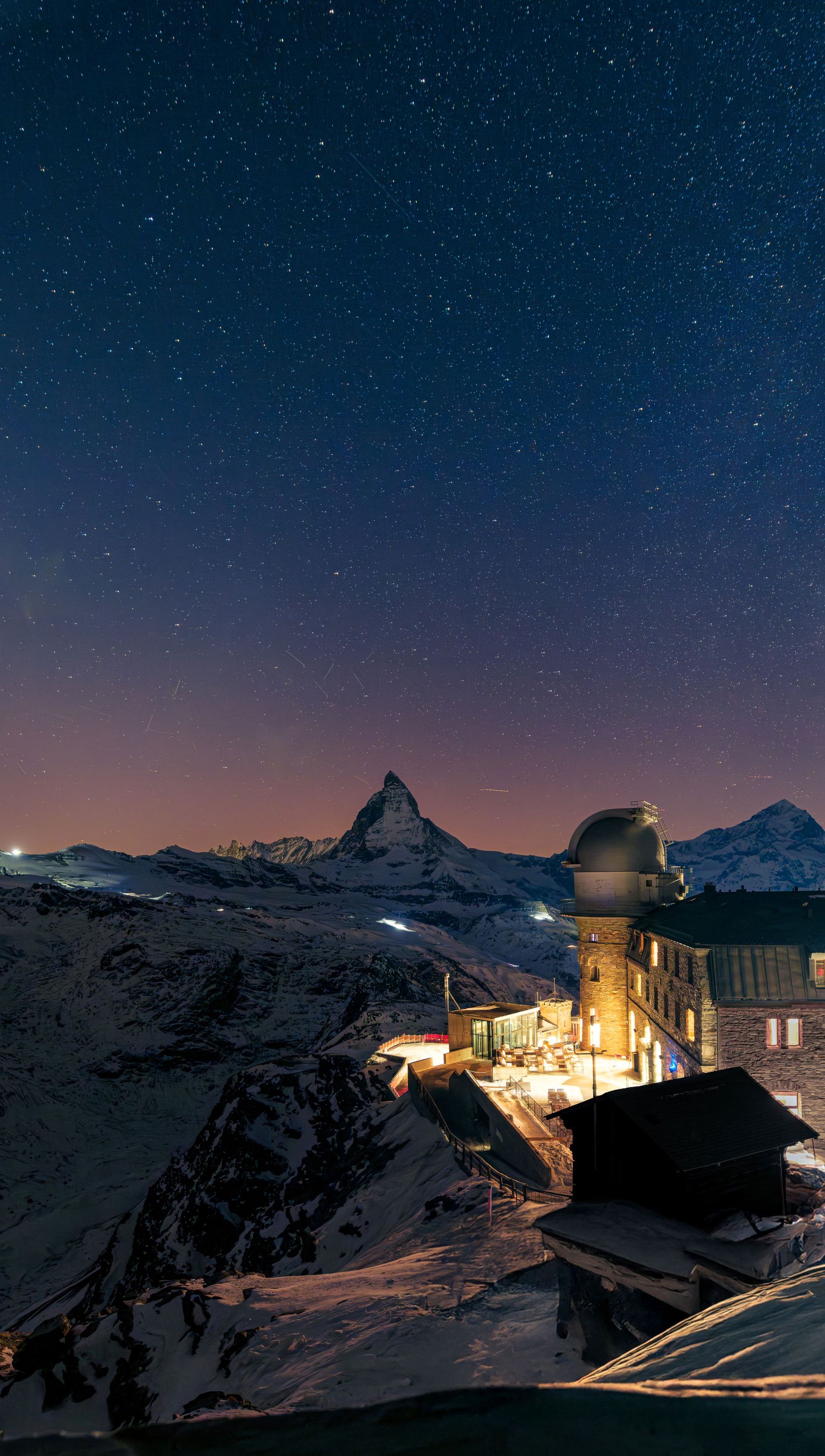
Under a lucky star
A visit to the Gornergrat Stellarium observatory
It is probably one of the best-kept secrets on the Gornergrat: under one of the two domes of the 3100 Kulmhotel Gornergrat is the Gornergrat Stellarium, an observatory of the Universities of Bern and Geneva. It is open to the public as part of guided tours. Our reporter visited astronomer Timm Riesen and took part in one of these tours.
A hairdryer for the telescope
Friday afternoon on the Gornergrat. Large snowflakes are falling, the wind is blowing. Over a cup of tea, Timm Riesen tells me that the day is not going well: the mechanism that aligns and tracks the telescope isn’t working - for the first time in twelve years. As a temporary measure, he warms it up with a hair dryer because the lubricating grease becomes thick in cold weather and the control system shuts down the motors to protect them. So the telescope won’t be in use tonight. Nevertheless, he has a plan: we’ll just look into the sky with naked eyes when it is clear.
Romance and over a hundred e-mails
There’s time to talk until the tour starts. I ask Timm if there are any guests he remembers in particular. Yes. Once, a man asked him for permission to propose to his partner in the dome. The woman was to have no idea, a companion would film the whole thing, and Timm Riesen would pretend to be part of the group and just be holding on to something technical. “It was fun,” he says.
And himself? On Sunday, when he goes back down to the valley, he’s already thinking about the more than one hundred e-mails that need to be looked at and answered. I admit to him that I had imagined it all to be more romantic than that. He is a romantic at heart, he says, but after twelve years, there is a certain amount of routine that creeps in. Peace comes later when the hotel is closed: then he’s the only person up here at night. “And then there’s more romance.”
Today, however, he is not alone: his tour starts at half past five, and I’m going with him.
An observatory in a hotel
We climb under the dome. The telescope is at a standstill, but Riesen is still giving us a tour, in English. The hotel was built long before the telescopes. In the 1960s, astronomy on the Jungfraujoch was in high demand, he explains, and the civic community of Zermatt, which owns the building, allowed domes to be installed on the towers. A guest asks if the telescope is vibration-free. “I wish,” says Riesen. Normally, a telescope stands on a pillar that extends through the entire building down to the bedrock and does not touch the building at any point, so it remains free from vibrations. Here, the pillar extends only one floor deep. And the building moves: when the sun warms the stone, the hotel sways back and forth, and the telescope sways with it. Riesen measures this motion and automatically calculates it for each new target in the sky.
Another guest wants to know whether this is one of the largest telescopes in the world. “Actually more of a small one,” says Riesen. But the full moon fits into its field of view twice. Researchers and schools use it remotely, and Riesen usually works from his office at the University of Bern. In the event of rain or strong winds, the dome closes automatically.
One floor down, he shows us pictures. First, Orion with its belt and sword. Something pink shimmers faintly in the sword. “It’s not a visual distortion,” says Riesen, “it’s a nebula, larger than the full moon.” To the naked eye, it looks like a star. Then it goes further and further away, all the way to the Andromeda galaxy. Its light travelled 2.5 million years:
Cold and quiet
Later that evening, the sky is almost clear. Riesen leads us part of the way up to the viewing platform. He shows us the North Star at the end of the handle of the Little Dipper. Because the Earth’s axis points almost exactly at it, it remains in virtually the same place for us, while the other stars seem to circle around it during the course of the night. Then Pegasus, high above us. “To see a horse with wings in it, you would probably also need some Greek wine,” Riesen joked during the tour.
It is only a brief moment, but impressive: the mighty mountains in the moonlight, the stars above us.
Next morning I drove down to the valley. The telescope remained silent, but the visit ended under a lucky star: Riesen had had a lot to show and tell. His pictures were still going through my mind. I didn’t see the fog that evening. But now I know it’s there. And I’m taking something home with me that I didn’t used to have: curiosity about the sky.