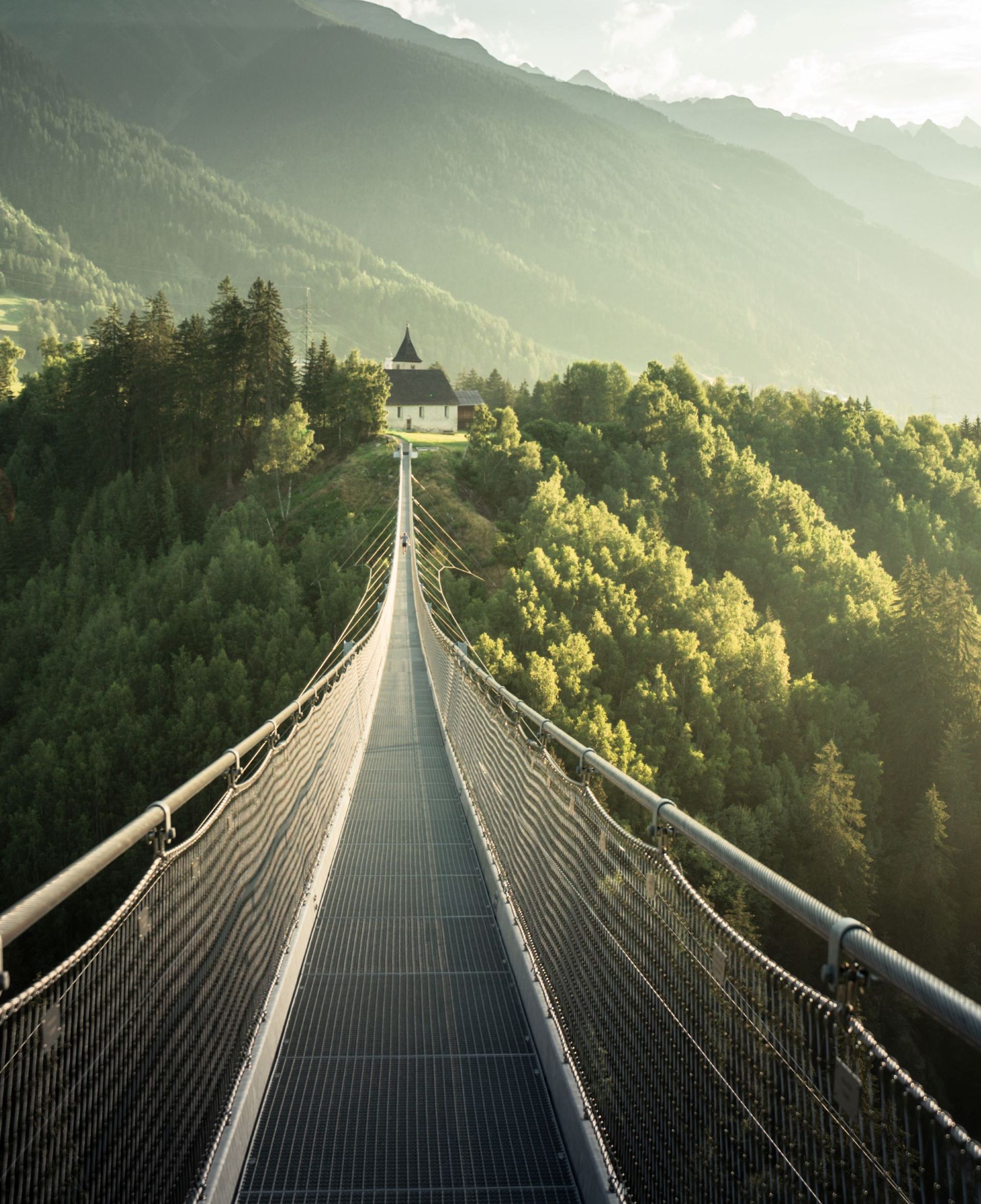
la pendenta
"Six years, six weeks"
270 metres long, almost 100 metres above the Anterior Rhine: la pendenta near Disentis is the longest suspension bridge in Graubünden. It wasn’t born out of a master plan – but out of the tenacity of an association, the trust of a village and an idea that simply didn’t go away.
There are projects that fail before they begin. And there are projects where you eventually stop doubting – because the idea is stronger than any resistance.
la pendenta is one of those projects.
Christian Loretz remembers exactly where he was when the results of the referendum on the municipal contribution came through. Fishing on the Oberalp Pass, having taken the MGBahn up there. “The results are out,” said his wife. “I said: Don’t look. It’s bound to have been accepted.” The Disentis electorate had rejected the proposed contribution of CHF 390,000 – in response to a request for a referendum after the municipal parliament had given its approval.
But that wasn’t the end. It was the start of the second attempt.
A gorge that divides
To understand why la pendenta was created, you need to know the Rhine Gorge near Cuflons. It lies between Disentis and the hamlet of Mumpé Medel – a wild, steep gorge through which the young Anterior Rhine flows. Anyone wanting to cross it on foot had to climb around 100 metres in altitude on both sides. For schoolchildren, for the elderly, for everyday life: simply not reasonable. The first idea to build a suspension bridge here came up in 2013. It was not pursued. In 2018, Loretz and some of his colleagues took up the idea again – this time with more resolution. “The main idea was to create a network – for the village, for links to public transport, for everyday life. It was only during the fund-raising that we realised that the project also had potential in terms of tourism.”
Six people, six years
They founded an association. Six people drove the project forward in their spare time – a bridge builder, a trustee, a banker and other specialists. “It just happened that way,” says Loretz. “Everyone brought exactly what was needed.”
Approval came. The funding – CHF 2.4 million – was secured, as far as the club could tell. The municipality was to contribute CHF 350,000. Parliament agreed. Then came the petition. Eighty signatures were enough to bring the project to the public. And the people said no – narrowly.
“A disappointment,” says Loretz. “But I was convinced that people weren’t against the project. Only against funding from the municipality.”
What followed was plan B: a private investor stepped in and took over the amount that the municipality did not pay. Two intensive months of convincing. Then: commitment. And thus the green light.
The village pitches in
What happened next surprised even the initiators. The association began to sell pendenta metres – a symbolic linear metre, for one thousand francs per piece. More than 450 were sold. In a municipality with 2,000 inhabitants. “A quarter of the population came on board,” says Loretz. “That really impressed me.”
New orders came in week after week. When construction began and there was something to see, there were even more. The association organised visits – people came almost every other week to find out how things were going. “You could sense: that’s our project.”
Six years of planning, six months of construction, six weeks of assembly. “It took us six years to plan,” says Loretz. “And it took six weeks to assemble the entire suspension bridge.”
270 metres. 100 metres deep.
With a span of 270 metres, la pendenta is the longest suspension bridge in the canton of Graubünden. It connects the Sontga Gada Church in Disentis with the hamlet of Mumpé Medel and crosses the Rhine Gorge near Cuflons – almost 100 metres above ground level.
Technically, the length is less spectacular than the height. “Creating the rope bridge itself wasn’t the hardest part,” says Loretz. “The challenge was the terrain, the logistics and the years of planning.”
Once completed, the bridge was handed over to the municipality of Disentis as a gift, which is now responsible for its maintenance. What began as an idea of two to three people is now owned by the village.
Anyone walking across the pendenta today – looking down to the Anterior Rhine and the Rhine Gorge deep beneath their feet – has little idea of what it took to make this 270-metre stretch possible. Courage. Setbacks. And a village that eventually engaged in the idea.
When Loretz stepped out of the Sontga Gada Chapel that November morning and saw a thousand people in front of him, he knew: it had been worth it. Every sleepless night, every refusal, that evening on the Oberalp Pass. “You know, these thousand people are only here because of this bridge.” He can still picture it clearly today – and, as he says, it gives him “goosebumps” when he thinks about it.
Excursion tip: Senda Desertina Disentis Railway Station – Circular Trail
13 km | 560 m | 3 h 50 min | easy
The circular trail starts at Disentis station and leads via Fontanivas with its small bathing lake down to the Anterior Rhine – past soapstone cliffs and glacial mills to the Cuflons Gorge, where the la pendenta bridge offers a view into the depths.
Along the way, 14 churches and chapels shape the landscape: the Romanesque chapel of Sontga Gada (12th century) with old murals and the baroque St. Mary’s Chapel in Acletta are the most impressive stations. The hamlet of Segnas impresses with its well-preserved Valais log buildings. From the top of the Muntatsch, you will enjoy a wide view of the Medelserg Glacier and Surselva before descending through the monastery forest back to the station.
The circular trail is usually also open in winter. Accessible on Matterhorn Gotthard Bahn to Disentis.
pendenta.ch | schweizmobil.ch/en/hiking-in-switzerland/route-680